SoftspaceAR Prototypes 01–05
From January to November 2022, I built and released a series of prototype apps to explore the design space for a general-purpose productivity tool that harnesses two key breakthroughs in consumer spatial computing: passthrough AR and hand tracking. These prototypes were published to Twitter and Substack as an experiment in open development, growing a significant following among those watching the intersection of spatial computing and tools for thought. This work resulted in additional funding and distribution opportunities for Softspace, including a pre-seed investment from Betaworks and partners, and the August 2023 launch of Softspace on the Meta Quest app store.”
Prototype 01: Dropbox Spatializer
The first prototype combined several ideas our team and users had long wanted to test: 3D force-directed graphs, immersive folder structure exploration, passthrough augmented reality, and controller-less hand-tracked UI. Prototype01 let users log into their Dropbox account and spatialize image-rich folders into a navigable 3D environment, using hand gestures to move through and manipulate the space. Read more →
Prototype 02: Writing in AR
Prototype02 tackled writing head-on. The goal was to prove that it’s possible to write comfortably, productively, and enjoyably inside a passthrough augmented reality app. The metric for success was simple: could I write for one solid hour in the prototype? The answer was yes—the first draft of the Prototype02 blog post was written entirely within the app. A key discovery: making text box backings opaque rather than transparent made writing significantly more enjoyable, as my brain was no longer overloaded by conflicting visual information. Read more →
Prototype 03: Ordinospatial Layouts
Prototype03 explored deep interoperability with existing tools by making Softspace workspaces interpretable as markdown files. The challenge was reconciling markdown’s inherently ordinal (sequential) nature with the spatial freedom that AR affords. The solution was an experimental “ordinospatial” layout system: content flows down columns, columns spread horizontally across a plane, and planes stack front-to-back. This system enforces strict ordering while allowing movement along all three spatial dimensions—any configuration can be unambiguously exported to markdown. Read more →
Prototype 04: Spatial Knowledge Graphs
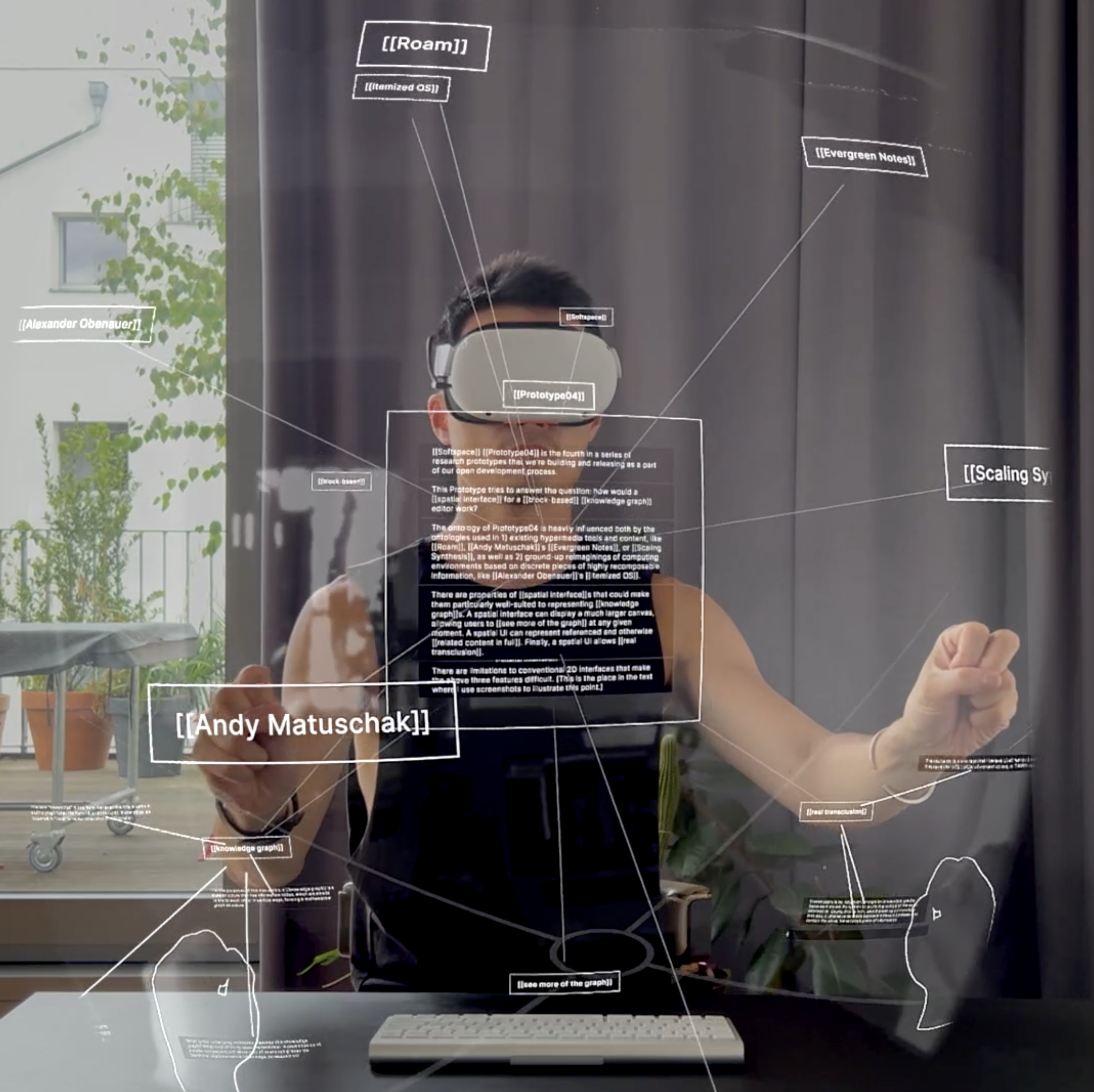
Prototype04 asked: could a spatial UI let you work with the true shape of your ideas? Drawing on evidence that knowledge is fundamentally graph-like—from citations and mind maps to the popularity of tools like Roam Research—this prototype implemented a 3D spatial canvas where text blocks link to topics via double-bracket syntax, and a force-directed simulation automatically draws related items together while pushing unrelated ones apart. The system supports true transclusion: any content block can belong to multiple topics simultaneously. Read more →
Prototype 05: Toward a Real Tool
The fifth prototype marked a turning point—the first to build deliberately on its predecessors rather than striking out into new territory. It combined the knowledge graph paradigm of Prototype04 with lessons from Prototype03, adding four major features: an in-headset web browser for accessing the internet and saving images, full image support for visual research workflows, text level-of-detail rendering so distant text remains legible, and the ability to expand multiple topics simultaneously. This prototype demonstrated that the experimental groundwork was ready to become a real tool for real work. Read more →